CHORE QUEST
Gamifying Independence Through Play
A bespoke Progressive Web App designed to help children develop independence through personalised routines, positive reinforcement and thoughtful systems design.
"The best technology isn't always something you buy. Sometimes it's something you build with the people who will actually use it."
Note: The public GitHub repository documents the architecture and design case study. ChoreQuest is a private family application and is not an open-source project.
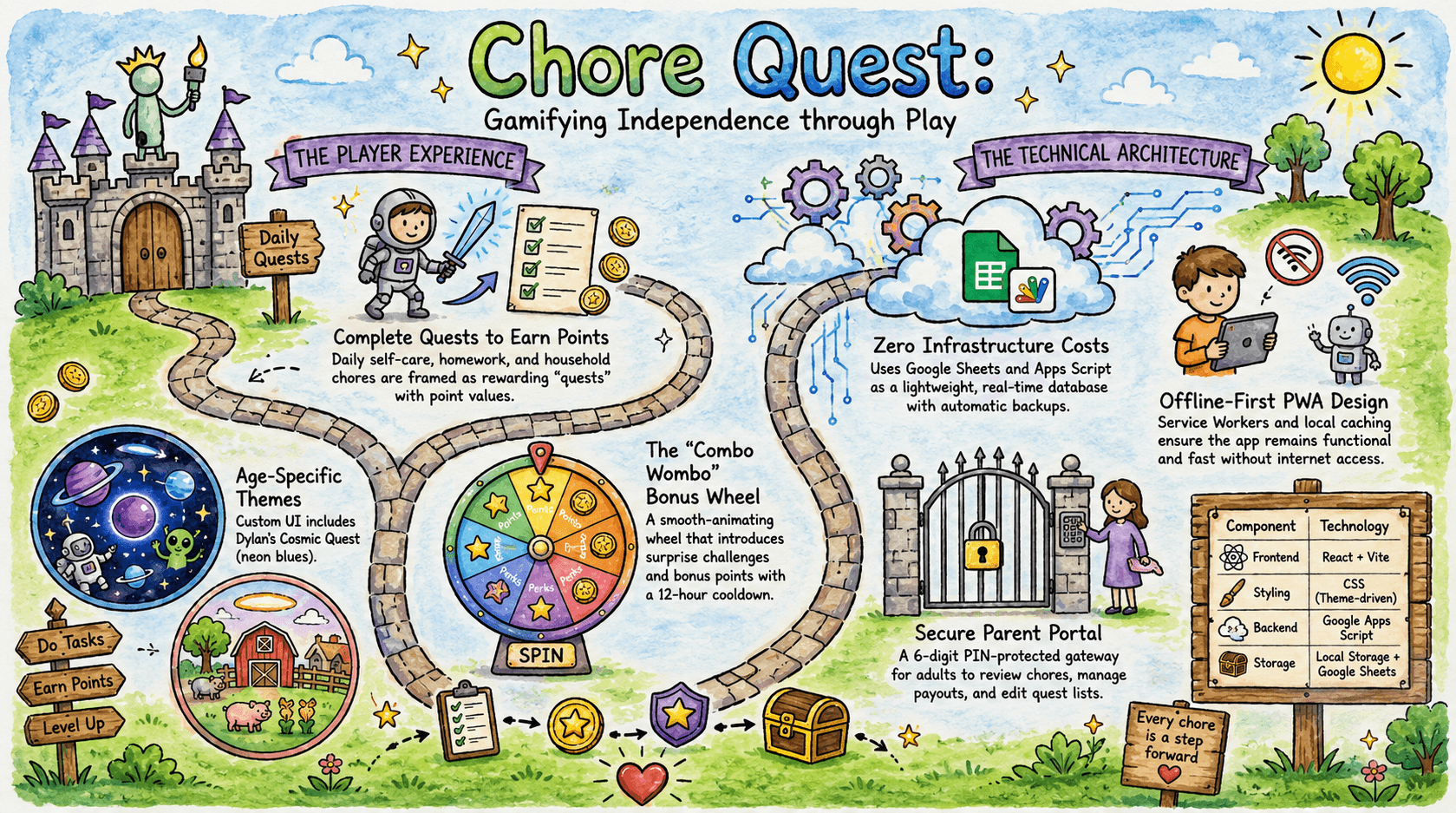
Progressive Web App (PWA)
Child Autonomy & Routines
Zero-Cost Serverless (Sheets)
Child-Led Co-Design
THE CHALLENGE
Like many self-employed parents, school holidays often meant balancing client deadlines while repeating the same reminders throughout the day.
- "Brush your teeth."
- "Put your clothes away."
- "Make your bed."
- "Tidy your room."
The issue wasn't that the children were unwilling to help. The problem was that every task relied on another verbal reminder. Eventually, the parent became the notification system.
"I wanted to remove myself from that loop. Rather than another paper checklist or reward chart on the fridge, I wanted to build something that encouraged independence while still feeling fun. That idea became ChoreQuest."
THE PHILOSOPHY
The best technology isn't always something you buy. Sometimes it's something you build with the people who will actually use it.
Co-Designing with Dylan & Robyn
Instead of designing an app in isolation, I invited my children into the development process. Dylan and Robyn spent an afternoon drawing characters, suggesting features, inventing names and discussing how they thought the app should work.
That simple decision completely changed the project. The children weren't being given another app. They were helping to create one. That sense of ownership became one of the biggest reasons the project succeeded.
FROM DRAWING TO DIGITAL PRODUCT
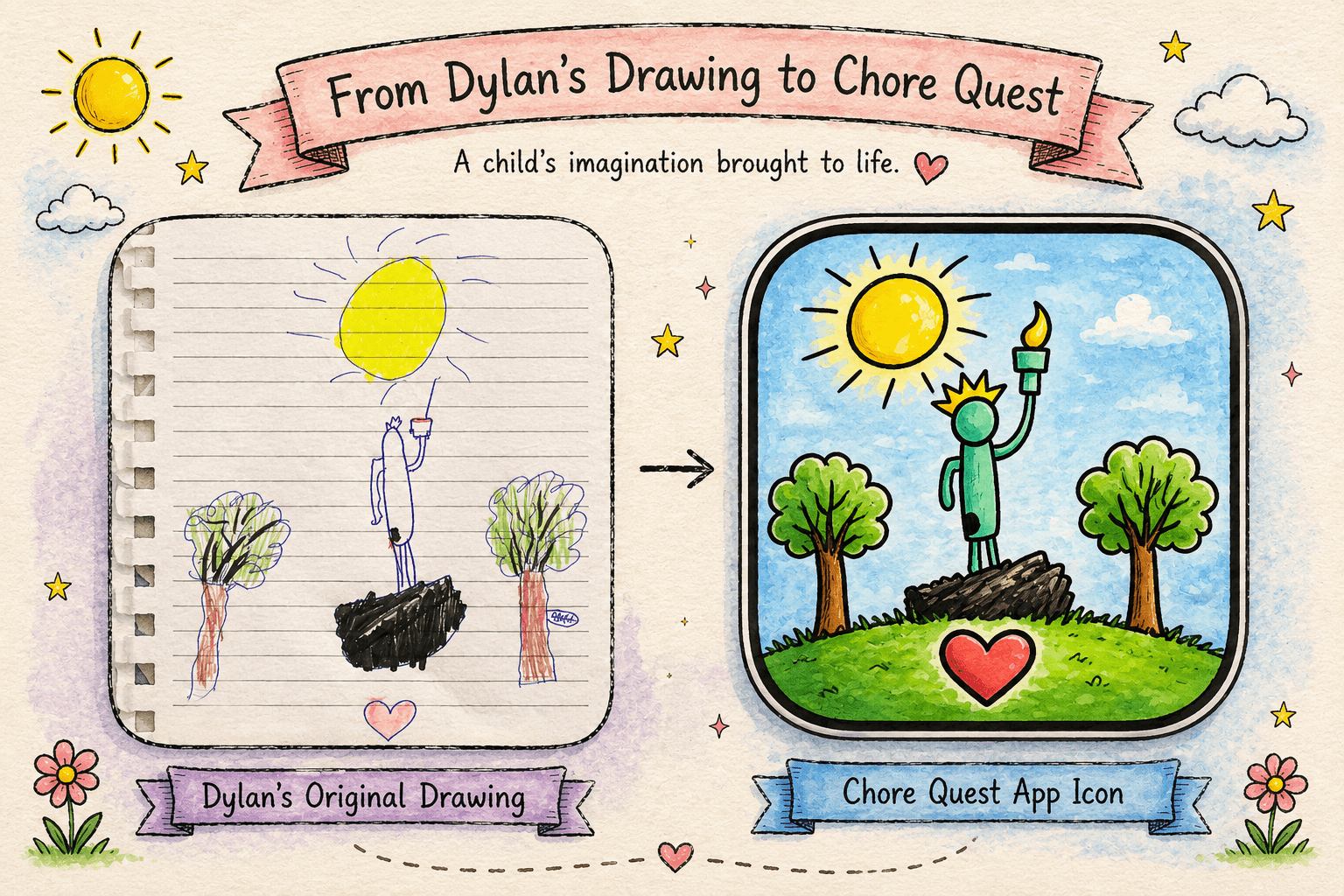
One of Dylan's drawings became the foundation for the entire visual identity.
His picture showed himself standing on a rock, holding a torch beneath a bright yellow sun, surrounded by two trees with a heart below.
Rather than replacing that artwork with polished corporate branding, I refined it into the application's favicon and expanded the same visual language throughout the project.
The illustrations used across the portfolio, technical diagrams and supporting artwork all evolved from that original drawing. The technology grew from a child's imagination rather than the other way around.
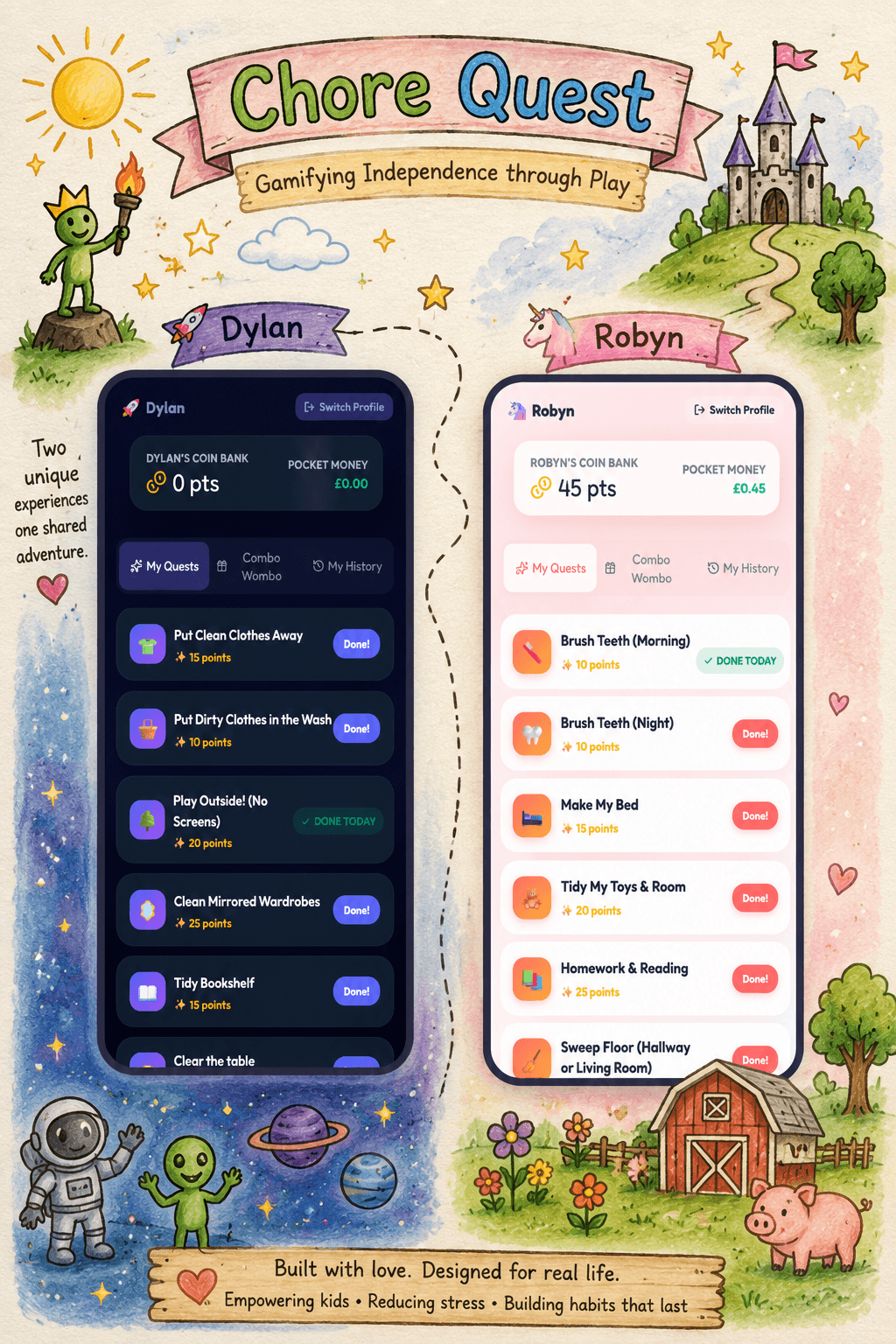
ONE APPLICATION. TWO COMPLETELY DIFFERENT EXPERIENCES.
Although ChoreQuest runs from a single codebase, neither child sees the same application.
Built around space exploration, using deep navy blues, vibrant purple highlights and space-inspired artwork tailored to Dylan's preferences.
A softer world of pastel pinks, warm corals and playful farm illustrations designed to feel inviting and fun for Robyn.
Behind the scenes, both experiences share exactly the same logic. The interface simply adapts to the child using it.
TURNING CHORES INTO QUESTS
Every everyday responsibility becomes a quest. Completing tasks updates progress immediately while building towards pocket money and personal achievements.
Instead of repeatedly asking children what still needs to be done, they can simply open the app and see their own progress. The aim was to make responsibility engaging.
COMBO WOMBO
Routines can quickly become repetitive. To keep the experience feeling fresh, ChoreQuest introduces a once-daily bonus feature called the Combo Wombo Wheel. Named by Robyn.
Children spin the animated wheel to unlock surprise challenges worth additional points:
- A silly dance for one minute
- Helping a sibling
- Wash your hands while singing a song
- Tidying a forgotten corner
The surprise element keeps the experience enjoyable without distracting from the underlying goal of building positive habits.
DESIGNED AROUND REAL LIFE
Technology should work around family life, not dictate it. ChoreQuest was designed as an installable Progressive Web App, meaning it behaves much like a native mobile application while remaining lightweight and easy to maintain.
If the internet connection drops, children can continue completing quests without interruption. Progress is stored locally before synchronising automatically once connectivity returns. Children shouldn't lose progress simply because the Wi-Fi disappears.
PARENT CONTROLS
Behind the child-facing experience sits a secure parent portal protected by a six-digit PIN.
- Create and edit quests
- Assign tasks to one or both children
- Review completed activities
- Award pocket money & manage points
- Reset daily progress & system settings
DESIGNED FOR FOCUS: REDUCING OVERWHELM FOR ADHD BRAINS
Traditional chore apps often overwhelm children with sensory noise, complex menus, and persistent notifications. ChoreQuest was purposefully built to provide executive functioning support without cognitive strain.
Zero Overwhelm
No ads, no pop-ups, no pushy upsells or flashing distractions. A calm, clean environment that lets neurodivergent children focus on one routine at a time.
Offline Frictionless
Loading spinners and connectivity dropouts disrupt momentum and executive function. Full offline capability ensures task completion is instant anywhere.
Sustained Interest
The once-daily Combo Wombo Wheel introduces just enough novelty and gamified joy to keep children returning daily without dopamine-chasing overload.
Predictable Feedback
Visual points feedback and tangible progress markers provide immediate positive reinforcement, empowering self-directed routine habits.
THE WEEKLY SWEET: FROM PASSIVE TREATS TO FINANCIAL LITERACY
How shifting from passive buying to earned pocket money transformed two children's relationship with money.
I used to take the children to the shop once a week for a sweet and buy it directly. It was a passive transaction where money had no connection to personal effort.
Now that both children are over 6, they have their own debit cards. They wanted the independence of tapping their own cards in store. ChoreQuest redirected money I was already spending into earned pocket money.
Twice this month, having worked for the money sitting in their accounts, both children voluntarily skipped buying sweets-choosing instead to save up for Google Play and PlayStation credit!
LIGHTWEIGHT ARCHITECTURE. FULLY FAMILY OWNED.
Rather than introducing unnecessary infrastructure, I deliberately selected an architecture that matched the scale of the project.
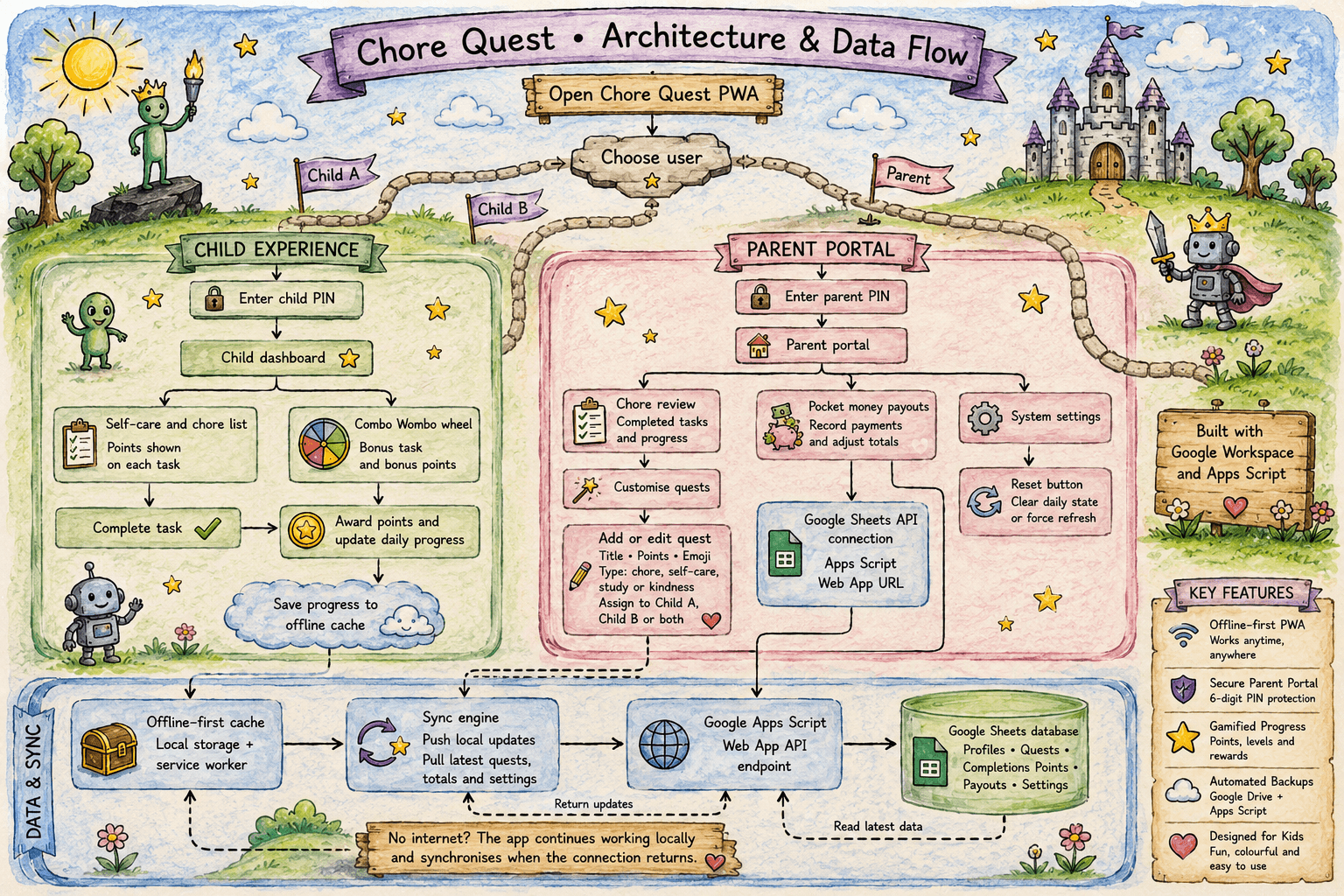
The frontend is built using React, TypeScript and Vite. Google Apps Script provides the application logic while Google Sheets acts as a lightweight, transparent data store.
This approach keeps infrastructure costs at zero while allowing the family to retain complete ownership of their own information. Parents can inspect, recover and manage the underlying data without specialist tools or complex administration.
CHOREQUEST VS MYCHOREBOARD & COMMERCIAL APPS
Comparing ChoreQuest against its closest commercial market alternative, MyChoreBoard.
| Core Feature | ChoreQuest (Bespoke PWA) | MyChoreBoard & Commercial Apps |
|---|---|---|
| Cost & Subscriptions | 100% Free Forever (Zero Infra Fees) | Monthly/Annual Subscriptions ($4.99–$9.99/mo) |
| Data Sovereignty | 100% Family Data Sovereignty (Private Google Sheets) | 3rd-Party Commercial Servers (Data tracking) |
| ADHD & Sensory Design | Zero Ads, Zero Pop-ups, Calm Uncluttered UI | Ad-supported tiers, aggressive upselling, noisy UI |
| Offline Capability | Full Offline PWA + LocalStorage Sync | Requires constant active internet connection |
| Personalisation | Dual Co-Designed Themes (Cosmic Quest & Star Farm) | Generic one-size-fits-all UI templates |
| Creative Ownership | Built WITH the children (Child artwork favicon) | Pre-packaged third-party software |
TECHNICAL SUMMARY
MORE THAN A CHORE APP
ChoreQuest demonstrates a wider design philosophy. Technology should adapt to the people using it.
Not every project requires cloud infrastructure, subscription services or enterprise-scale architecture. Sometimes the best solution is the one that understands the real problem, involves the intended users from the beginning and remains simple enough to be useful every day.
This project wasn't created to launch a global SaaS platform. It was built to solve one family's recurring problem through thoughtful systems design, personalised experiences and lightweight architecture.
The result is a digital product that encourages independence, supports routine building and shows children that technology is something they can help create, not simply consume.
"ChoreQuest may have started as a way to stop repeating 'Have you brushed your teeth?' every morning. It became something much more meaningful. It became an opportunity to show two children that their ideas had value, that software could be creative, and that the technology they use every day doesn't have to be something built by somebody else. Sometimes the most rewarding projects aren't the biggest ones. They're the ones built for the people sitting around your own kitchen table."